

In precision electronics manufacturing, small improvements in process capability can create outsized gains in performance and cost efficiency. That’s why Bead Electronics’ recent investment in a next-generation swaging press represents more than a production upgrade. It’s a meaningful advancement in the engineering, manufacturing, and delivery of custom contact pins, with meaningful gains in speed and flexibility.
By modernizing a proven swaging platform with advanced automation, digital controls, and modular tooling, Bead Electronics is expanding what’s possible for customers who require high-performance connector components with tight tolerances and fast turnaround.
Why Swaging Matters in Contact Pin Production
Swaging has long been a core manufacturing process at Bead Electronics, and for good reason. Unlike machining, which removes material, swaging reshapes metal through controlled forming.
This approach offers several inherent advantages for contact pin manufacturing:
- Tighter dimensional consistency across high volumes
- Minimal material waste, making it more cost-effective and sustainable
- Improved structural integrity, ideal for demanding electrical applications
Because swaging produces parts with excellent repeatability and virtually no scrap, it’s particularly well-suited for industries where reliability and efficiency are non-negotiable.
What’s Different About the Next-Generation Swaging Press
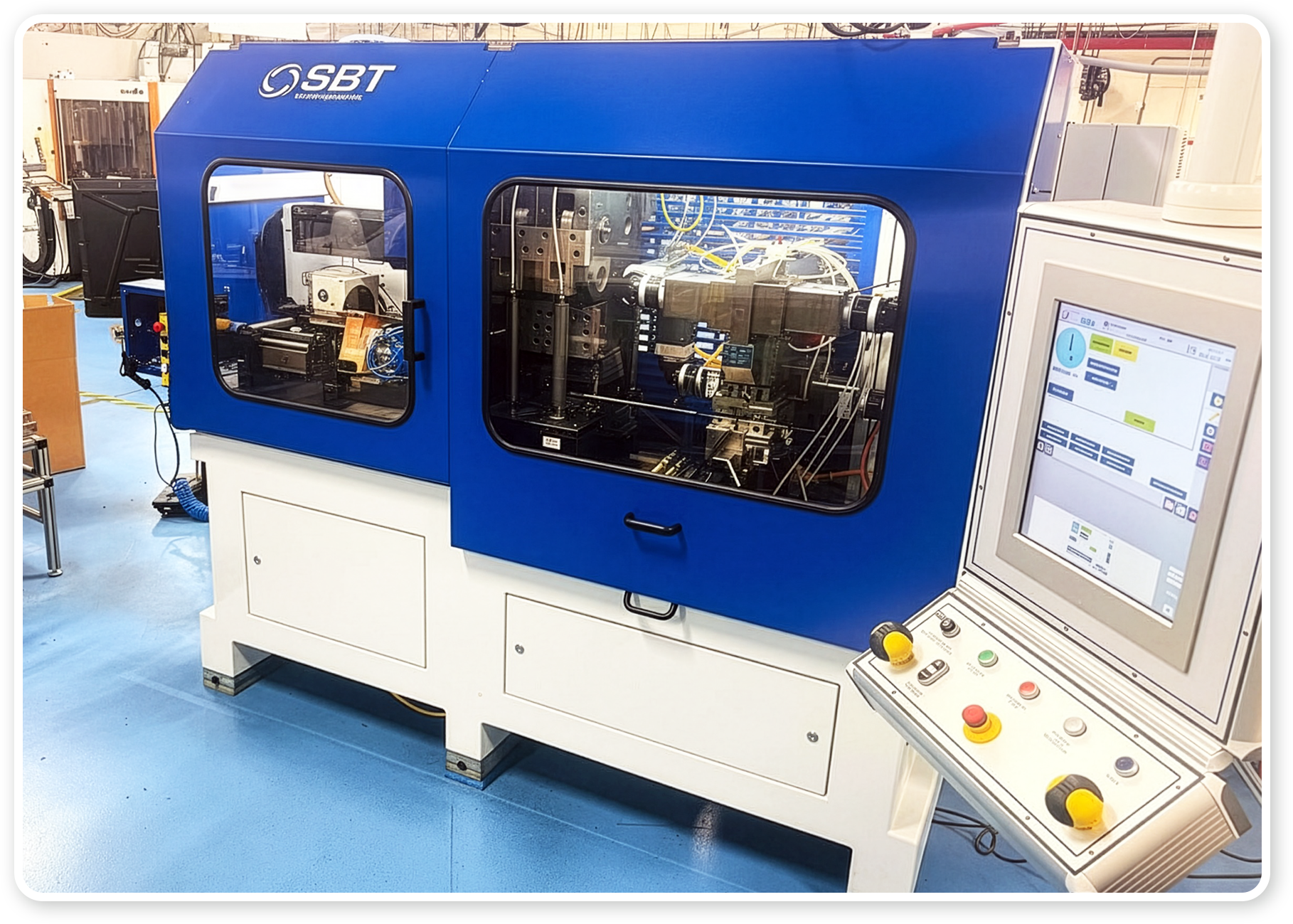
Bead Electronics’ new programmable swaging press builds on these foundational strengths while introducing significant enhancements in speed, flexibility, and control.
Reverse engineered by SBT (Stanzbiegetrchnik GesmbH) in Austria from one of Bead’s original presses, the system integrates modern servo motors, advanced digital controls, and a modular tooling architecture. The result is a machine that can adapt more quickly to changing design requirements while maintaining the precision Bead is known for.
Key improvements include:
- Faster setup and changeovers, reducing downtime between jobs
- Expanded design flexibility, supporting a wider range of solid and hollow pin geometries
- Improved process control, enabling tighter tolerances and repeatability
- Shorter lead times, especially for custom and low-to-mid volume runs
This flexibility is particularly valuable for customers developing new products or refining existing connector designs, where iteration speed can impact time to market.
Supporting Customization Without Compromising Efficiency
One of the biggest challenges in custom contact pin manufacturing is balancing customization with production efficiency. Traditional machining methods often introduce trade-offs: greater design freedom at the cost of higher material waste, longer lead times, and increased unit cost.
Swaging (especially with modular, programmable tooling) minimizes those trade-offs. The new press allows Bead Electronics to adjust tooling, pressure, and process parameters with greater precision, enabling customization without sacrificing consistency.
For customers, that means:
- Greater freedom in pin geometry and wall thickness
- More cost-effective hollow pin designs
- Reliable scalability from prototype to production
Strengthening U.S.-Based Manufacturing Capabilities
Beyond performance gains, this investment reinforces Bead Electronics’ commitment to advanced U.S.-based manufacturing. By upgrading core production equipment rather than outsourcing or simplifying offerings, Bead continues to support customers who value domestic manufacturing and engineering collaboration.
The next-generation swaging press positions Bead to serve a broad range of industries, including automotive, datacom, medical, industrial, and transportation, with the speed and precision modern applications demand.
Looking Ahead
As connector requirements grow more complex and timelines grow tighter, manufacturing capability becomes a competitive advantage. Bead Electronics’ latest swaging press is a clear signal of where the company is headed: toward smarter automation, deeper customization, and continued leadership in precision contact pin manufacturing.