

Medical connector design challenges are rarely isolated to a single variable. In medical devices, connector performance is directly tied to patient safety, device longevity, regulatory compliance, and system reliability. As devices become smaller, faster, and more complex, connectors—and more specifically contact pins—often become the limiting factor in engineering feasibility.
In many cases, Bead’s custom contact pins are specified not because engineers prefer custom components, but because space constraints, the absence of a standard interface, or two incompatible standards leave no viable alternative.
Below is a technical breakdown of the most common engineering constraints driving medical connector design decisions.
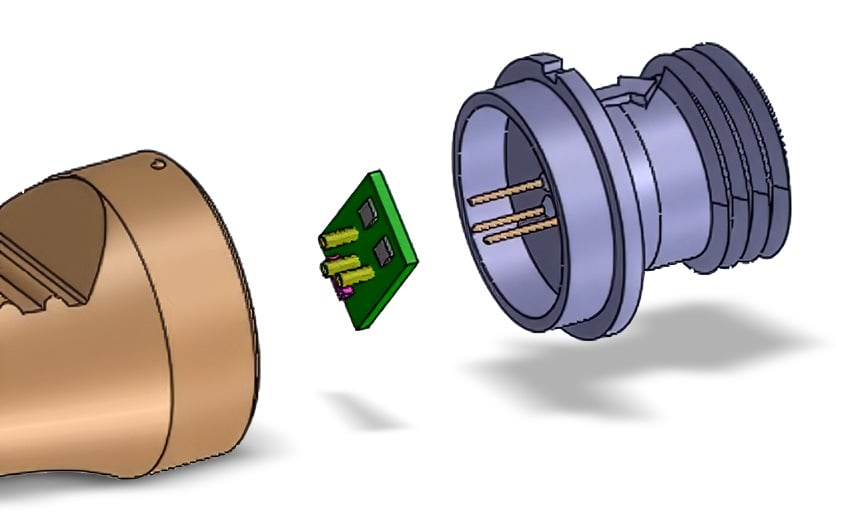
Why Off-the-Shelf Connectors Often Fall Short
Medical device engineers frequently discover that no standard connector exists for their application. When two widely used standards don't mate with each other, or when an existing standard simply doesn't fit within the space envelope of a new device, a custom solution becomes the only path forward.
This is one of the most common reasons medical OEMs and connector manufacturers come to Bead. The situation typically falls into one of three scenarios:
- No industry standard exists for the specific application or form factor.
- Two standards exist but are incompatible with each other, creating an interface gap that must be bridged.
- A standard exists, but the required pin geometry or size doesn't fit within the device's physical constraints.
In each case, the answer is the same: a custom-engineered contact pin designed from the ground up for the specific application. This is where Bead's design and manufacturing agility becomes a decisive advantage.
Miniaturization and Space Constraints in Medical Devices
Medical devices are trending toward smaller, lighter, and more portable architectures. Handheld diagnostics, wearable monitors, minimally invasive surgical tools, and compact imaging systems all compress functionality into tighter envelopes.
Standard catalog connectors are designed for broad industrial use. They are often:
- Too large in diameter
- Too long for compact stack-ups
- Dependent on bulky housings
- Incompatible with tight internal routing
When internal packaging constraints dominate the design envelope, engineers must reduce diameter, shorten engagement length, or eliminate housings entirely.
Custom contact pins enable:
- Reduced overall diameter
- Controlled engagement depth
- Bent or formed geometries for tight internal routing
- Direct PCB or housing integration
In compact medical assemblies, even fractions of a millimeter matter. A pin that is slightly oversized, too long, or geometrically rigid can force redesigns elsewhere in the system. By tailoring the pin geometry itself, engineers can preserve internal architecture without compromising electrical or mechanical performance.
Bead’s approach to miniaturization is grounded in our core manufacturing process and engineering-first culture. Unlike machined contacts, which remove material to achieve shape, our proprietary scrapless swaging process forms metal by displacing it. This cold-forming approach preserves material integrity and maintains precise dimensional control, enabling small-scale geometries that are repeatable and consistent across millions of parts.
When There Is No Standard — or Two Standards That Don’t Mate
One of the more overlooked medical connector design challenges is interface incompatibility.
Scenarios include:
- A proprietary internal architecture that must mate with an external standard (e.g., TE, Molex, Amphenol).
- Two industry standards that do not physically or mechanically mate.
- A legacy interface that must connect to a modern subsystem.
In these cases, the connector cannot be selected from a catalog because no off-the-shelf component solves the mechanical mismatch.
Custom contact pins can be engineered to:
- Precisely mate with established connector platforms
- Maintain contact alignment in constrained geometries
- Bridge incompatible standards without redesigning the full system
- Integrate into custom housings or directly into PCBs
Rather than redesigning the entire connector ecosystem, engineers can customize the contact interface itself. This minimizes system disruption while preserving compatibility.
Electrical Performance and Signal Integrity
Medical devices increasingly rely on high-speed data transmission for:
- Imaging systems
- Patient monitoring
- Diagnostic equipment
- Embedded control systems
Electrical challenges include:
- Maintaining low, stable contact resistance
- Minimizing signal loss
- Controlling impedance
- Preventing noise coupling
Dimensional consistency directly impacts signal integrity. Variability in pin geometry affects contact force, engagement depth, and resistance stability.
Swaging, as a forming process, reshapes material rather than removing it. This provides:
- Tight dimensional repeatability
- Minimal material waste
- Strong structural continuity
Because swaging improves consistency across high volumes, it supports the electrical reliability required in demanding applications.
For medical connectors, where signal instability can compromise diagnostics or monitoring accuracy, geometric precision is not optional.
Mechanical Reliability and Mating Cycle Durability
Medical connectors must endure:
- Repeated mating and unmating
- Portable device vibration
- Surgical handling stresses
- Retention force requirements
Mechanical reliability depends on:
- Contact force stability
- Structural integrity of the pin
- Resistance to deformation
- Tolerance stack-up control in multi-pin arrays
Swaged pins offer structural advantages because material grain continuity is preserved during forming. Unlike machined components, which remove material, swaged pins maintain structural density and strength.
For hollow pins in particular, wall thickness uniformity is critical. Custom swaging processes allow precise control over:
- Wall thickness
- Tip geometry
- Retention features
- Engagement profile
This reduces long-term fatigue risk and ensures stable mating cycles.
Sterilization and Material Compatibility
Medical environments impose material constraints not present in many industrial applications.
Connector pins may be exposed to:
- Autoclave sterilization
- Chemical sterilants
- Moisture and condensation
- Biological contaminants
Material selection must account for:
- Corrosion resistance
- Plating durability
- Biocompatibility requirements
- Gold thickness for wear resistance
Standard catalog pins typically offer limited base material and plating combinations.
Custom contact pins allow:
- Nickel underplating control
- Alternative alloys
- Geometry adjustments to accommodate plating thickness
When sterilization cycles are repeated over a product’s lifecycle, plating adhesion and thickness consistency become critical to maintaining conductivity and reliability.
Direct PCB Integration and Design for Manufacturability
Many modern medical devices eliminate bulky connector assemblies in favor of direct-to-board connections.
Advantages include:
- Reduced part count
- Fewer failure interfaces
- Simplified assembly
- Improved compactness
Custom pins can be engineered for:
- Solder integration
- Automated insertion processes
- Controlled insertion forces
Direct PCB mounting reduces assembly complexity by eliminating intermediary housings and secondary retention components. Fewer mechanical interfaces mean fewer potential failure points over the product’s lifecycle.
From a design-for-manufacturability (DFM) perspective, reducing subassemblies minimizes tolerance stack-ups, simplifies inspection, and lowers cumulative mechanical and electrical risk. In regulated medical environments, that reduction in variability directly supports long-term reliability and validation consistency.
Engineering Without Compromise
Medical connector design challenges are driven by constraint stacking:
- Reduced space
- Increased electrical performance requirements
- Sterilization exposure
- Regulatory pressure
- Incompatible standards
In many cases, Bead’s custom contact pins are used not as a luxury, but as a necessity—because space constraints eliminate standard connectors, no standard exists, or two standards do not mate.
Precision swaging combined with programmable tooling and advanced process control expands design flexibility while maintaining repeatability and production scalability. Engineers can achieve tighter tolerances and more complex geometries without introducing variability into high-volume manufacturing.
For medical device development teams, engaging at the contact pin level early in the design process often prevents downstream redesign cycles, reduces validation risk, and shortens time to market
If your design is constrained by geometry, interface compatibility, or material limitations, validating a custom pin solution early in development can reduce risk and accelerate time to market.
Solving Connector Constraints at the Source
Medical connector design challenges compound quickly. Space constraints affect geometry. Geometry affects electrical performance. Material choices influence durability under sterilization. Each variable is interconnected.
When standard connectors align with the mechanical envelope and performance requirements, they are efficient solutions. But when space is limited, no standard exists, or two standards do not mate, forcing a catalog component into the design introduces risk.
Custom contact pins allow engineers to control diameter, geometry, materials, and engagement characteristics at the source. Addressing constraints at the pin level early in development often prevents downstream redesigns and protects long-term reliability in regulated medical environments.
Partnering with Bead on Your Next Medical Design
Engineering a medical connector is rarely a simple task of selecting a catalog part. More often, it requires a design partner who can start from your application requirements — not from a shelf of standard products — and build a precision component that fits exactly where it needs to fit, performs exactly as it needs to perform, and can be manufactured consistently at the volumes your production demands.
At Bead Electronics, that is exactly what we do. With over 110 years of swaging expertise, 500+ patents, and a dedicated engineering team that engages directly with your design challenges, we help medical manufacturers move from concept to qualified production pin faster and with greater confidence.
Common FAQs with Medical Connector Design Challenges
What are the biggest medical connector design challenges?
The most significant challenges include miniaturization, maintaining signal integrity, ensuring mechanical durability, surviving sterilization cycles, and managing tolerance stack-ups. Interface incompatibility between standards is also common.
Why are custom contact pins used in medical devices?
Custom contact pins are used when standard connectors cannot meet space constraints, when no suitable standard exists, or when two standards do not physically mate. They allow engineers to tailor geometry, materials, and finishes to application-specific requirements.
How does miniaturization affect connector reliability?
Miniaturization reduces allowable tolerances, increases sensitivity to misalignment, and limits housing size. Smaller geometries amplify the impact of dimensional variation, making precision manufacturing critical.
What materials are best for medical connector pins?
Material selection depends on the application but often includes high-conductivity copper alloys with controlled nickel and gold plating. Corrosion resistance, wear durability, and biocompatibility must be evaluated alongside electrical performance.
When should engineers move from off-the-shelf to custom connectors?
Engineers should consider custom solutions when standard connectors introduce packaging conflicts, fail sterilization requirements, cannot meet electrical tolerances, or when incompatible standards must be bridged.